
The Q4 Tax Planning Checklist: 5 Moves to Make Before December 31

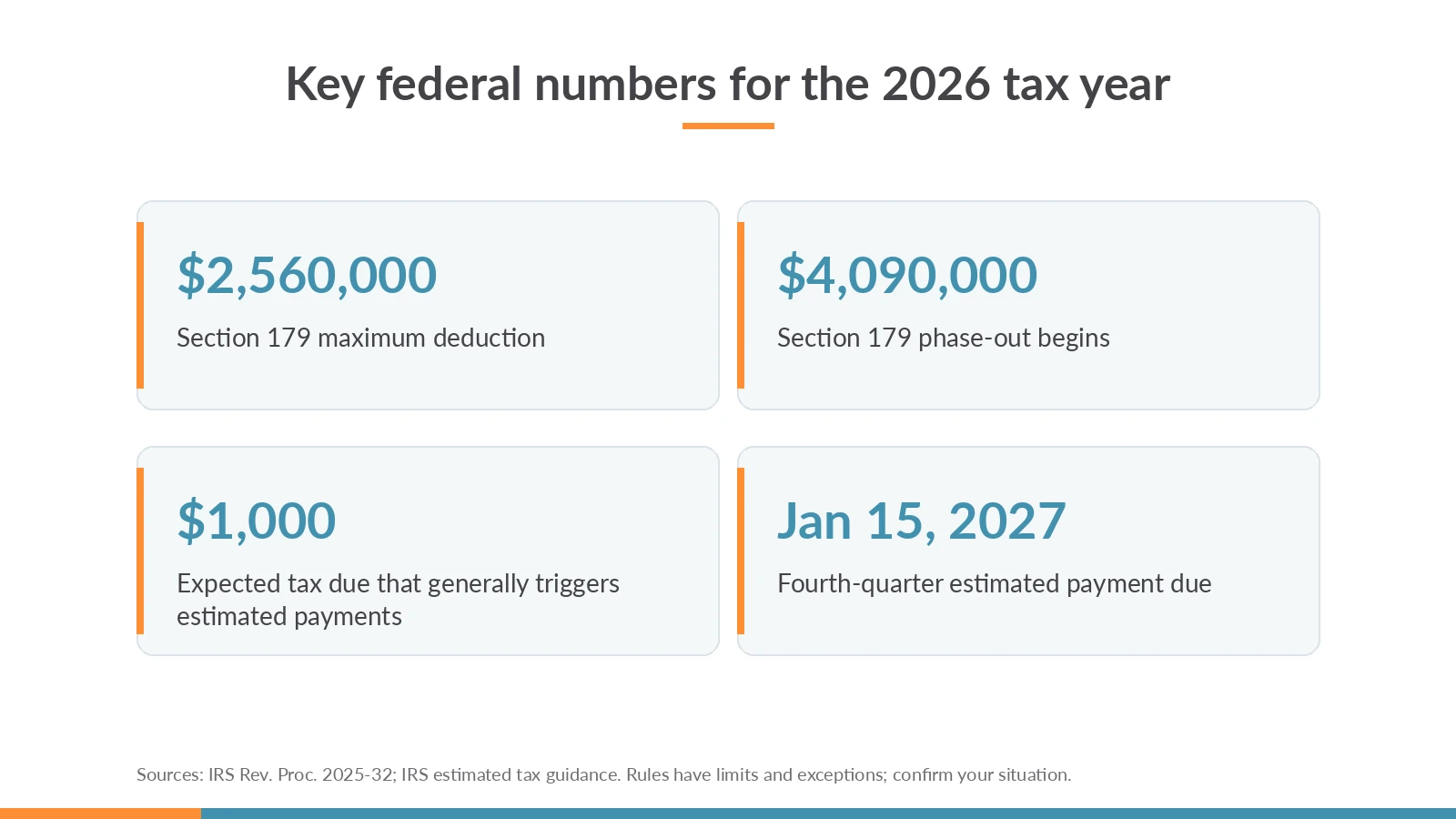
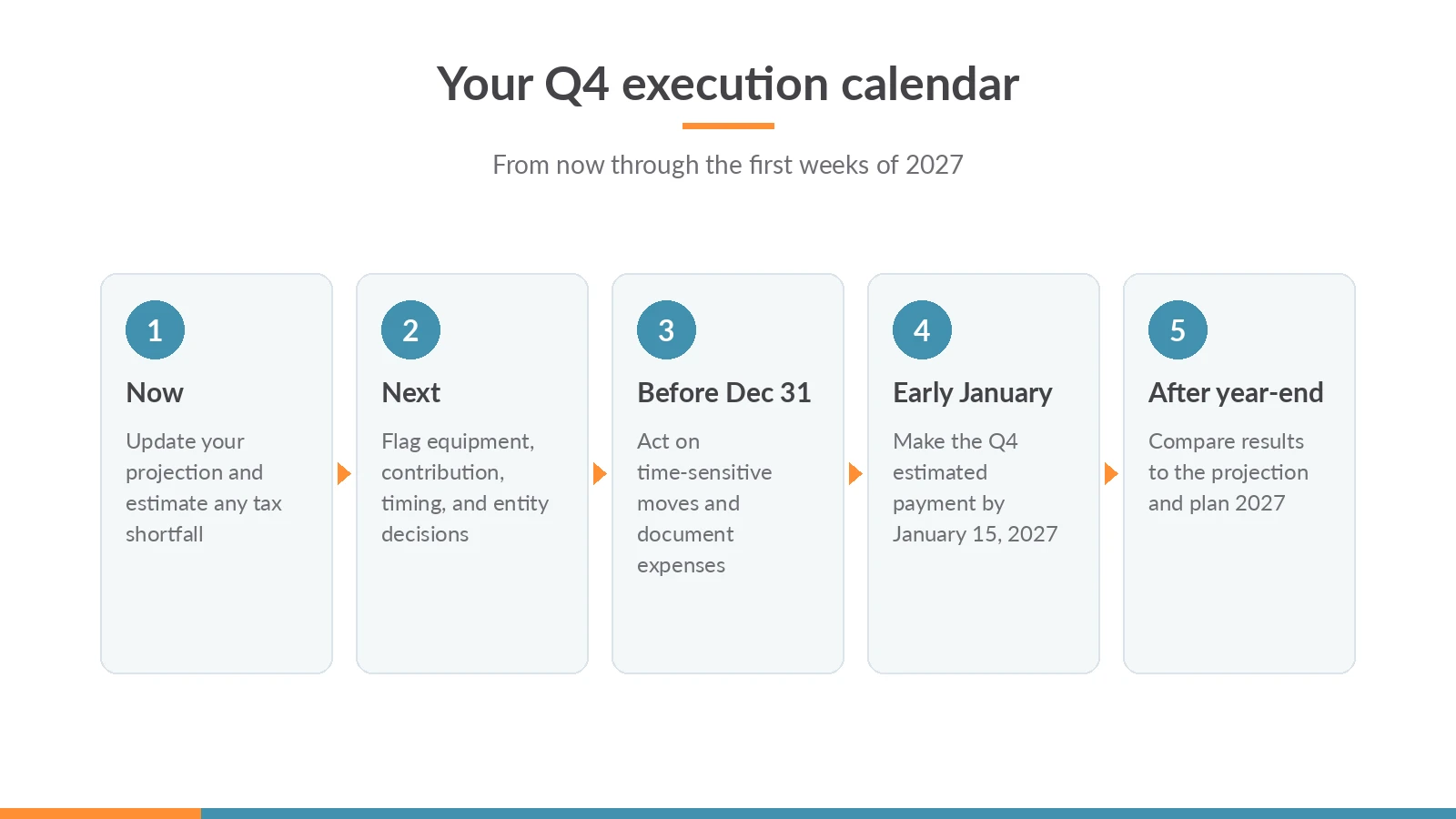
Before December 31, update your tax projection, decide which expenses or income to time into this year, set up retirement contributions, reconcile your books, and review your entity for 2027. Some of these must be done by year-end; others only need preparation now. The final 2026 estimated tax payment is due January 15, 2027.
1. Project your 2026 tax before you spend anything
Start with actual results through October, then add a realistic estimate for November and December. Include platform payouts, sponsorships, open invoices, contractor costs, and owner pay.
Compare the projected tax with what you have already paid. The IRS says you generally need estimated tax payments if you expect to owe $1,000 or more, and those payments cover both income tax and self-employment tax. If you are behind, plan a true-up for the fourth payment, due January 15, 2027.
2. Time expenses and income on purpose
On the cash method, legitimate business expenses paid by December 31 generally count for 2026. Annual software, professional services, insurance, and supplies are common candidates. Some prepayments must be spread over more than one year, and a deduction is never a reason to buy something the business does not need.
Equipment has a stricter test. For 2026, the Section 179 limit is $2,560,000, with a phase-out starting at $4,090,000 of qualifying property. The item must be placed in service, meaning ready and available for business use, by December 31. Ordered or paid for is not enough. Business use must generally be more than 50%. See IRS Publication 946.
The opposite can also make sense. If this year is unusually high, review whether legitimate invoice timing moves income into January. Never delay income improperly or break a client agreement.
3. Set up retirement contributions now, even if you fund them later
2026 limits from the IRS cost-of-living table, before catch-up contributions:
- 401(k) elective deferrals, including solo 401(k): $24,500
- Total defined contribution and SEP limit: $72,000, subject to compensation limits
- IRA: $7,500
Deadlines differ by contribution type. A solo 401(k) employee deferral generally must be elected by December 31, while the deposit can follow by the filing deadline, including extensions, per IRS Publication 560. Employer and SEP contributions can generally be made by the return due date, including extensions. Size any contribution to what your cash reserves can support.
4. Reconcile every account and income source
- Bank, credit card, and loan accounts
- Stripe, PayPal, and platform payout accounts
- Payroll, receivables, and owner draws
Collect contractor W-9s now. For 2026 payments, Form 1099-NEC is generally required at $2,000 or more and is due January 31. That date falls on a Sunday in 2027, so the practical deadline is Monday, February 1, 2027.
5. Review your entity before 2027 starts
An S corporation election is not automatically better. It adds payroll, a reasonable salary requirement, and compliance costs, which must be weighed against expected savings.
Timing: for a calendar-year business, Form 2553 can be filed any time during the year before the election takes effect, or within 2 months and 15 days after the year starts. For 2027, that means by March 15, 2027. Planning before December 31 gives you time to model the decision first.
A common scenario
Illustrative example, not a specific client.
A consultant has a strong year and, in mid-December, orders new computer and camera equipment to get a deduction. The order ships late and is not set up until January, so it does not count for this year. Meanwhile, the bigger issue, estimated payments well below the projected tax, goes unnoticed until the return is prepared.
What we'd do
- Run a projection with actual numbers through October, not a guess.
- Make a one-page decision list with a deadline next to each item: December 31, January 15, February 1, or March 15.
- Move the Q4 estimate into a separate tax account before making any year-end purchase.
Frequently asked questions
Can I deduct equipment I order in December but receive in January?
Generally not for 2026. Section 179 and depreciation depend on when the item is placed in service, so equipment set up in January belongs to the next tax year.
What if my books are not clean enough to plan?
Start with reconciliation. A projection built on unreconciled numbers can point you to the wrong decisions. Cleaning up October and November now still leaves time to act before year-end.
Want a second set of eyes on your year-end numbers?
Book a discovery callSources
This article is for general information only and is not tax or legal advice. Tax rules depend on your circumstances and may change. Talk with a qualified tax professional before acting on it.